Showing posts with label Aburi. Show all posts

Sunday, 3 January 2016

Umegaokasushi no Midori. Value-for-money Sushi doesn't get better than this.

Kani Miso Salad. 800 Yen
I've struck gold.

In a land where almost everything is expensive, locating and having a meal here is akin to winning the sushi lottery (bar obtaining a reservation at Sukiyabashi Jiro or Sushi Saito).

I am of course, talking about Umegaokasushi no Midori, or Sushi Midori as it is more commonly known.

Sushi Set. 2000 yen.
Top Row: Negitoro Handroll and Anago
Middle Row: Ikura, Kuruma Ebi, Tamago Yaki, Crab Leg Sushi, Uni
Bottom Row: Hotate (Scallop), Chutoro, Tai and Chutoro

Located at the bottom of an expressway among rows of restaurants, Midori Sushi bravely puts in a claim as the best in its class for offering value-for-money sushi. 2000 yen is enough to get you a set as shown above, while anything more can buy you an indulgent meal fit for a king. The quality here is also much better than expected, which gives you the ultimate bang for your buck. The Kani Miso Salad (Crab innards mixed with miso) was a powerful prelude to the sushi carnage that followed soon after.


Triple Ponzu Appetizer. 800 yen
Ankimo (Monkfish Liver), Octopus and Shirako (Cod Fish Sperm Sacs) drizzled with Ponzu
and topped with Ohba and Wakame Seaweed

Take for instance this appetizer. For 800 yen, I get 3 thick, large medallions of monkfish liver and generous helpings of shirako and octopus enough to feed 3 people. The ankimo is soft and creamy, as is the shirako. The octopus is a little more chewy and the ponzu lends a refreshing and acidic aftertaste to whet the appetite.

Anago (600 yen). Let me know if you find the sushi rice.
This has got to be the ultimate steal. For 600 yen, I got a piece of eel the length of my forearm (>30cm). The Anago despite its large size, still maintained a melt-in-your-mouth texture and the thick, sweet and savoury sauce was the icing on the cake that took me to eel heaven.


Clockwise from Top: Chutoro, Magurozuke, Otoro and Aburi Chutoro
Ordering the different forms of Tuna, I am glad to say that all 3 (Akami, Chutoro, Otoro) fared competently and are definitely worth much, much more than the price they charge.

Otoro. (500 yen a pop)
This is perhaps the only place where I can order 5 Otoro Nigiris at one go and not even worry about my wallet later. Each piece is well marbled and juicy, albeit a little veiny due to the intermuscular fascia commonly present in Otoro. But at 500 yen a pop, I am certainly not complaining.

Sujiko Nigiri. 400 yen
The next moment of epiphany was when the Sujiko (Salmon Roe still held in egg sacs) arrived. The chef had to use a large shiso leaf to fully contain all the salmon roe and they give you a sheet of nori to wrap it yourself. Carefully placing the inter-connected sujiko and rice inside the nori, a few drops of shoyu and one bite later, time stood still and the only sound I heard was the individual popping of each single roe as I burst them slowly with my teeth.

Top to Bottom: Aburi Hotate (Blowtorched Scallop) Otoro and Scallop
The ingredients themselves are fresh and clean tasting. While certainly not comparable to the top-tier sushi restaurants that reside in Tokyo's luxury district, they more than hold their own with its mid-range quality and high turnover ensures that no customer gets seafood from the previous day.


Aburi Hotate
The Aburi options here prove to be a hit as well with the foreign customers. Salmon, Otoro, Scallop and Botan Ebi are among the few options available for guests who crave for a different flavour for their sushi.

Pictures plastered all over the walls also feature specials of the season. The menus have English in them and the friendly waitstaff are happy to up sell and recommend their house specialities.

In all honesty, I have absolutely no idea how they are able to command such low prices given the generally expensive food cost of seafood. I can only assume that they buy in bulk and enjoy economies of scale, while the never-ending horde of customers waiting outside their doors provide a steady and constant revenue stream.

If there's only one thing that's not so pleasant, it is the queue. Waiting times are at least 2 hours (I waited 3 hours for my table to be ready).

But the good folks here have purchased a ticketing machine and employed a system similar to clinics where customers can get a queue number and wait for their number to be called.

My advice? Go early and get a queue number and you can head off and spend the next 2 hours shopping and wandering in Ginza's shopping area. But do use your judgement and estimate roughly when your table will be ready so you will be present when they call your number. Come back later in a state of ravenous hunger and unleash the beast, while dealing serious damage to the world's seafood supply in the process.

Cheap food with respectable quality, Sushi Midori is truly the find of the decade for me.

Yet.


Umegaokasushi no Midori (Sushi Midori)
7-2 Ginza, Chuo-ku 104-6601, Tokyo

Operating Hours
Monday to Saturday: 1100-2200. (Last Order at 2130)
Sunday and Holidays: 1100-2100 (Last Order at 2030)

Closed on New Year's (1st January)

Nearest Station: Ginza or Shimbashi Station on the Ginza Subway Line.

Note: The shop is located below an expressway along the train tracks, so use the train tracks/expressway as a point of reference when using GPS to locate the restaurant.

Thursday, 4 September 2014

Kaiho Sushi: Stick to the Aburi Sushi.

Hotate Mentaiyaki (Scallop grilled with Spicy Cod Roe Mayonnaise) $25

I love Cuppage Plaza despite its sleazy and seedy outlook, for it houses authentic Japanese Food and many local Japanese frequent the various joints here. With a good mix of Sushi-yas, Yakitori Restaurants and Izakayas, I can take my pick and select whatever I feel like having, and on this occasion, it was Sushi.

Taking a leap of faith, I ventured into Kaiho Sushi with a friend, but I decided not to go for Omakase and play it safe with a few ala carte items and a sushi set.

For starters, my friend ordered the Hotate Mentaiyaki and it arrived warm and moist. I tried a small teaspoon of it, and I was happy to find that the scallop was sweet and juicy and the Mentaiko was lip-smackingly savoury and creamy but did not overpower the shellfish. I particularly loved the bits that were charred which gave a nice contrast to the dish itself.


Aburi Salmon Nigiri ($5 a piece)

Aburi Sushi is always a delight to order and this was no different. The salmon was lightly cooked on the outside, but still retained its texture and flavour with the tsume (sauce that is put on sushi) bringing it up a notch.


Wagyu Aburi Nigiri ($15)

Blowtorched Wagyu on Sushi Rice. It's a no-brainer, impossible-to-fail sushi. The wagyu was smoky, juicy and evenly marbled and drizzled with a little tsume. If only it wasn't $15 a piece I would be popping this into my mouth freely.


Sushi Mori Set (9 pieces of assorted sushi.) $58
2 pieces Hirame (Flounder)
1 piece Otoro (Fatty Tuna Belly)
2 pieces Tai (Sea Bream/Snapper)
2 pieces Salmon
2 pieces Akagai (Red Clam)

Sadly, this was the disappointment of the entire meal.

The menu stated "9 pieces of assorted sushi". I naturally assumed it would mean 9 different kinds of sushi. But the chef gave me 2 pieces of 4 different types of sushi, with one single otoro. I could not help but feel shortchanged. The tai and hirame are not exactly the most expensive of fish, and I felt he could have given a better variety. The only saving graces were the Salmon and Otoro. The others were barely passable in my books. Suffice to say I was so unwilling to part with $58 for this set.

Oh, and a word of warning. By the 4th piece, the wasabi present in the nigiri was overwhelming and I started tearing, and this comes from a person with a high wasabi-spice tolerance level. This being my first time here, I did not know that the chef would be so liberal with the usage of his wasabi, so do tell him to go easy should you ever come here.


Kohada (Gizzard Shad) Nigiri. $9 a piece


Kohada is usually salted and cured in vinegar in order to kill bacteria and remove the "fishy smell" commonly found in fish of the Hikari Mono (shiny matter) category. To bring out the true flavour, it is up to the chef to determine how much to salt the fish, and how long he must leave it in the vinegar in order for the marinade to penetrate through the skin and flesh so that he can achieve the optimal quality.

Attempting to give Kaiho Sushi another shot at the Edomae Sushi, I went for the Kohada and I realized it was a mistake.

Once again, I was let down because the taste was simply negligible and the finish was not as long as I would have liked. The fact that the skin of the fish here was quite rough as well, served as another negative indicator.

Frankly, it is quite difficult to go wrong with Aburi Sushi, and many places offer it nowadays, even in the massive sushi chain shops. I was hoping that Kaiho Sushi would be able to offer at least passable Edomae sushi alongside its blowtorched specialities, and it was found wanting. Despite its competence in Aburi Sushi, I could probably get better value elsewhere. I left feeling discontented. My stomach had its fill, but my taste buds were still left hanging.

Singapore has come a long way in the quality and authenticity of the Sushi served here. But am I only able to get good Edomae Sushi in restaurants that charge up to $300 for Omakase? Is there no place here that can do decent, traditional sushi without burning a hole in my pocket? Alas, my search continues...

For Kaiho, my advice is just to stick to the Aburi Sushi, and maybe go for the cooked items if you are feeling adventurous.


Kaiho Sushi
#03-01 Cuppage Plaza
5 Koek Road
6738 1315

Operating Hours:
Tuesdays to Sundays
Lunch: 1200 - 1430
Dinner: 1830 - 2300
Closed on Mondays

Nearest MRT Station: Somerset

Monday, 4 August 2014

Hakumai Sushi and Omakase: Great Sushi, Great Value.

Sashimi Platter: Salmon, Maguro, Botan Ebi, Swordfish, Sawara, Herring Roe, Torigai.


What happens when you get a craving for some really good sushi and you do not want your typical chain restaurants, but you are unwilling to spend hundreds of dollars for an Omakase?

You go to Hakumai, that's what.

Much as I would like to do a full Omakase with the works and extras, there are just times when the heart is willing, but the wallet says otherwise. That said, at $68.80++, Chef Gary has truly given me my money's worth, and has consistently maintained his standards, very much like my last visit.

Starting with a Sashimi Platter, each fish and ingredient was fresh and meticulously sliced and presented to me.


Truffle Chawanmushi with Prawn and Enoki Mushrooms.

I could not help but be taken aback by Gary's new take on his Chawanmushi. Piping hot egg custard swimming in a thick, strong dashi broth drizzled generously with truffle oil. With a little yuzu to cut through the richness and strength, this is comfort food on a whole new level.


Tai-kama Shioyaki: Salt-grilled Snapper Cheek

The hot food of Hakumai is not to be understated too. The chef showcases his mastery of the grill by simply salting the cheek of the Snapper and grilling it till the skin is crispy and slightly charred, and the flesh inside is flaky, moist and juicy. Throw your dining etiquette out of the window (or counter) and get your hands dirty!


Sushi Platter from top to bottom: Ikura gunkan, Aburi Scallop with Mentaiko, Aburi Mekajiki topped with yuzu pepper, Salmon and Maguro topped with bonito flakes.


The sushi today was as excellent as before. Generous slices of fish sitting snugly on a bed of Niigata sushi rice, with the blow-torching process melting the oils of the fish and giving it a nice smoky flavour.

Aburi Botan Ebi with Foie Gras (Additional Order: $30 for 2 pieces)

But no trip to Hakumai can ever be complete without their signature sushi: The blowtorched botan prawn topped with goose liver. This is truly an orgasmic experience where you need to close your eyes and fully appreciate the creamy, smoky, rich and freshness of each individual component. The prawn and goose liver go together like coffee and milk. Do not ever leave Hakumai without having this.


Chef Gary Ng

I can't recall a time where I was disappointed by Gary-san and his team. Service is prompt and friendly, and Gary's skills as seen and tasted in the sushi he makes, coupled with his jovial and cheerful nature gives me a relaxed and lively atmosphere for me to dine in. Hakumai is able to cater to different price ranges so it really gives customers more options and choice, and I'm glad to say the restaurant does not compromise on quality or quantity even if you spend on the less expensive items or set menus.

A place for all occasions, Hakumai gives you wonderful sushi without burning a hole in your pockets.


Hakumai Sushi & Omakase
#01-50A International Plaza
10 Anson Road
Singapore 079903
Contact No: +65 6224 4790

Operating hours:
Closed on Sundays
Lunch: 11.30am to 3.00pm
Dinner: 6.00pm to 10.30pm
(Last Orders are 45 minutes before closing)

Nearest MRT Station: Tanjong Pagar

Sunday, 18 August 2013

Hakumai Sushi and Omakase: Where Aburi meets Edomae

Aburi Otoro

I must confess, I am not a true purist. Try as I might to stick to tradition fully and follow the ways of old, I fall into temptation to try out new and innovative products that actually work well. This is the dilemma I face when I decide to have sushi.

While I highly revere and respect the Edomae style of serving sushi as it is; pure and unadulterated, Aburi comes along teasingly and I find myself unable to resist, and I have to make a trip to Hakumai, where my itamae Chef Gary-san is based in now. Some of you might know him from the old restaurant Kome (located at Keppel Club) and Hinoki (located at China Square Central) where he was before with partner Lawrence Chia (brother of Ronnie Chia who owns Tatsuya). They have went their separate ways and he has set up a small shop at International Plaza. Gary's sushi comes with a twist, adding a little extra special ingredient here and there in order to give the final product some additional oomph and burst of flavour.

Gary starts his sushi Omakase with a bang. Think a slice of fatty unctuous otoro blowtorched to melt the fats and lightly sear the fish to give it a smoky flavour. It was simply sublime.


Aburi Mekajiki with yuzu kosho
Mekajiki or swordfish is a dark horse sashimi amongst Singaporeans. Those of us who love this neta, appreciate it for its meaty texture and buttery mouthfeel that develops more as one slowly savours it. Gary scores and blowtorches the mekajiki and adds a pinch of yuzu pepper that brings out the flavour and also cuts through the oily-ness in order that it might not be too heavy. This is another must have for me.


Aburi Botan Ebi with Foie Gras
This, is Gary's signature and the peak of the omakase. A ball of sushi rice topped with a butterflied botan ebi, and with a piece of foie gras seared to perfection, sitting comfortably and looking ever so sexy. Gary drips a little sauce of reduced shoyu and mirin on top. This is undeniably aburi at its best. The freshness of the prawn was still evident despite it being torched. The foie gras, so seductively creamy, smoky and just bursting with buttery goodness just went so well together with the botan ebi like a match made in heaven. I could pop five of this in one sitting and die happy. This is what makes me go for aburi, and you can't say Gary did an omakase for you if he has not served this to you.


Aburi Hotate with Mentaiyaki (Seared Scallop with Spicy Cod Roe mayonnaise)
Coming in at a very close second is the Scallop with the Spicy Cod Roe mayonnaise which Gary makes in-house. The savoury, creamy Mentaiko gives an additional dimension to the sweet, bouncy and luscious scallop, resulting in a myriad of interlaying flavours that just balances and sits nicely.


Uni (Sea Urchin) Gunkan
After all the hype and fanfare with the aburi nigiri, Gary then brings me back down to earth (albeit a very nice comfortable spot) with his Uni. There is nothing fancy and innovative about this sushi. Just creamy uni on a bed of Koshihikari rice with nori wrapped around it. Sometimes, simple is best, and the uni here is the definition of it.
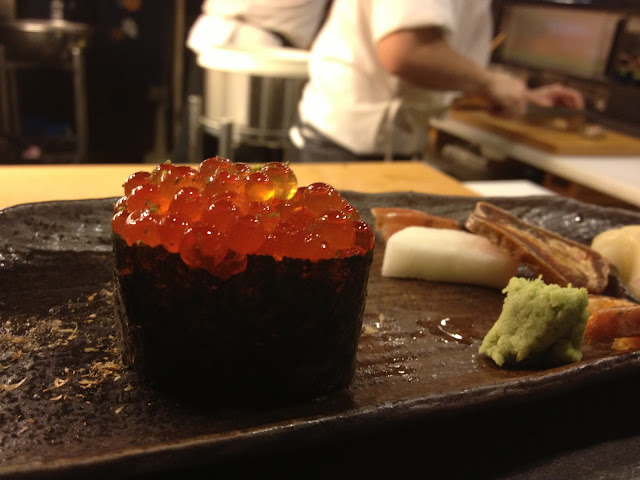
Ikura (salmon roe) gunkan
The same goes for the ikura. Though with this gunkan Gary grates a little yuzu zest and dusts it on top of the salmon roe. Pretty nice, but it is light-years away from the sake-soaked ikura I get at Meii Sushi, which incidentally, is just one level above Hakumai.

Tekka Maki (Minced Tuna Roll) with Bonito flakes

Most places would do negitoro (minced tuna belly with chopped spring onions) in the form of a temaki (handroll), but I definitely prefer it served in a form of maki like this as it allows me to taste the fish and the rice better due to the increase in exposed surface of the sushi.


Anago (Conger/Sea Water Eel)
Concluding the meal like any other omakase  is Anago. Sea eel is different from Unagi, which usually comes from freshwaters. Sea eel is often used to conclude an omakase as it is usually drizzled with a thick master stock that is heavily reduced to give it a sticky viscous texture and concentrated flavour. Good Anago should be able to achieve a melt-in-your-mouth texture. Unfortunately Hakumai's version on this is still below par and there is much to improve on.

Kyoho Grapes Ice Cream

Yuzu Sorbet
I was hoping for some Japanese musk melon to close the wonderfully satisfying meal, but Gary told me that they were out of stock. Nevertheless, they offer a range of flavours for their ice cream and sorbets like Kyoho Grapes, yuzu, goma and matcha. I chose the above 2 to end my meal on a light and refreshing note.

Edomae or Aburi? These are two schools of thoughts with their own individual arguments, and strengths and weaknesses. Traditional Japanese chefs will baulk and rage at the idea of using a blowtorch to spoil their perfectly moulded sushi. They see it as an insult and feel it compromises the integrity of their creations. On the flip side an itamae of the new era would choose to improve on his sushi further by selecting specific ingredients, or employing the use of other instruments  in an attempt to set their own mark and signature on the sushi and satisfy the ever-changing demands and tastebuds of the customer. While most people in Japan would stick to tradition, the same cannot be said for the other countries. It is a debate that can never be fully won by both sides, as it ultimately boils down to the taste of the customer and his individual beliefs.

As for me, I find myself gravitating more towards Edomae Sushi whenever I have a need to satisfy my own cravings. Having aburi sushi is all about being adventurous and involves a great deal of experimenting in finding a suitable ingredient to match the fish. There will be hits and misses. Having an omakase comprising of Edomae sushi, however, takes on a more formal setting where there is a basic form of respect for the itamae and his attempts to bring you the purest form of sushi dating back centuries. This is the reason why I fell in love with Japanese cuisine in the first place, and in my heart of hearts, I still want my sushi to be just as it was 300 years ago when it was being sold as street food in Edo (now modern day Tokyo).

That said, if you are looking to have sushi with a little twist and still get a wonderful experience, Gary has never failed me once with his creations. With his amiable and humourous nature, Gary is an easy-going chef where you can be at ease with yourself and the atmosphere and enjoy your blowtorched nigiri with no reservations (pun unintended).

Overall, Hakumai is a small little sushi-ya helmed by an old friend and friendly wait staff who are always at hand to assist you, and a fun and informal place to have an outstanding aburi experience.


Hakumai Sushi & Omakase
#01-50A International Plaza
10 Anson Road
Singapore 079903
Contact No: +65 6224 4790

Nearest MRT: Tanjong Pagar

Operating hours:
Closed on Sundays
Lunch: 11.30am to 3.00pm
Dinner: 6.00pm to 10.30pm
(Last Order are 45 minutes before closing)

Closed on Sundays