I remember my very first Wagyu.
It was back in 2007, and my elder brother who is a crazier foodie than me, told me of this "new type of Japanese beef" that was being sold in Astons' Specialties Katong for $38.80, which was a steal at that point in time. It was a USDA MBS (Marbling Beef Score) Grade 5 Ribeye cut, and the beef hailed from "Mayura Station", southern Australia.
"Wa- what?" I asked.
Prior to that, I was totally ignorant of Japanese beef and the intense marbling of the meat, and the processes in which the cow underwent to achieve such a high standard of grading, which gives the meat a rich, buttery flavour and a slight floral fragrance, which is a total contrast to the heavy, 'beefiness' of the typical Black Angus.
Fast forward a few years, wagyu now has become very accessible to the general public, with some restaurants offering it at unbelievable prices like $6.90 for a platter of wagyu slices. It has become a household name to be assosciated with "prime, luxury and highly-marbled beef"
Therein, lies the problem. By selling it at such low prices, something's gotta give and in this case more often than not, it is the quality of the beef that suffers. I have even heard of some restaurants attempting to 'fake' marbling by solidifying canola oil and placing it on the beef to make it appear well-marbled so that they can charge a premium for it. Another problem is that most customers will most probably not get the real McCoy, thereby ruining their first experience, which is a shame.
Secondly, there's wagyu, and then there's Japanese wagyu. One difference being that wagyu that is exported out of Japan is usually crossbred with another species like the Angus cow which results in a cow that has parents of different origins, (with the exception of
David Blackmore of Australia who is recognized by the Japanese Ministry of Agriculture to breed and raise pure-blood wagyu due to his efforts to replicate highly similar farming methods).
However, Japanese wagyu that remains in its own land, breeds only with other wagyu cows of the same species, and even the same region
, which results in a purer meat with its own individual tastes and characteristics. So in the case of Japanese wagyu, they can come from regions like Kobe, Kagoshima, Matsuzaka, and the legendary Mishima beef, which is only consumed in Japan strictly, and only 12 head of cattle is produced and slaughtered per year.
 |
| Mixed greens with yellow and red peppers and julienned carrots |
But that's another story. For now, I take you to Ginza, Tokyo where I had my very first real, authentic Japanese Full Blood Wagyu from the region of Kobe.
It took me a great deal of courage to head to Ginza, because of the region's infamy with ridiculously high prices, but after a great deal of research online, I found out that Gyu-an was tourist-friendly (they have English menus) with the prices stated clearly, so I would not be in for a rude shock.
I ordered the A5 Striploin, which was one of their prime items. They also have the A5 tenderloin which costs more if memory serves. Starting off with a refreshing salad dressed with yuzu vinaigrette which lightly teased my tastebuds, I prepared myself mentally and spiritually for the beef to arrive. 15 minutes later,
this arrived.
 |
| Japanese MBS Grade A5 Kobe Wagyu Striploin. 7500 yen (SGD $115 at point of purchase) |
Hello you beauty...
Ahem. Anyways, the wagyu came pre-sliced and sizzling smoking on a
teppan (hot plate) with onions beneath the meat to prevent overcooking, along with a scoop of homemade mash, carrots and long beans.
I could hardly care less about the sides as I just marveled at the sheer pristine and radiant nature of the beef. Now these are hardly words to describe beef which is usually robust, heavy bodied and well rounded. But such is the work and interpretation of the
Nihon-jin where they take anything of foreign origin and bring it up to new, unprecedented levels.
The beef was so, so tender but yet it still held its shape and structure. At first sniff, the meat combined the appetizing aroma of beef and somehow,
flowers. The taste? Each bite was a slice of buttery, beef heaven. This is a steak which appeals not so much to the carnivorous nature of men, but more the need of the divine. Nothing less.
Some hardcore beef lovers have gripes with the lack of "beefiness" in a meat so refined, but I'm glad to say that amidst all the "flowery and buttery" flavours, the "beefy" flavour is evident in the meat, thanks to the lightly seared outside of the beef which has been Maillard-ed sufficiently.
 |
| Rare or Medium Rare? |
The best doneness for beef is always medium-rare, as most would say. However, with Japanese wagyu, one can take one step down and order "rare", or even "medium raw" which allows you to better appreciate the flavour of the meat and its juices. That was perhaps, my one tinge of regret; not being adventurous enough. I am definitely ordering "rare" and below the next time I am fortunate enough to have pure Japanese wagyu.
 |
| Condiments from top to bottom: Ponzu, Goma and Rock Salt |
The meal came with a condiment platter of 3 types of seasonings. I saw some of my neighbouring diners pouring the
ponzu onto the teppan as it was sizzling. But being the purist I am, I just had to show utmost respect to the farmers, chef and the beef by just sprinkling the rock salt onto the beef. The salt drew the flavours out even further, and my tastebuds were in overdrive.
This was another one of those life goals which I am glad to have achieved and strike off my "to-do" list. The beef was truly a moment of revelation, and for the quality you are getting, the price is considered reasonable, taking into account that you are in Japan and in Ginza.
All I can say is, if you want a quintessential experience of Kobe wagyu but yet not burn a hole in your pocket, head down to Gyu-an where the friendly "
obasan" at the basement entrance
welcomes you warmly into their her abode like any good Japanese establishment. Cleanse your palate, calm yourself down, and just sink your teeth into a beef like no other.
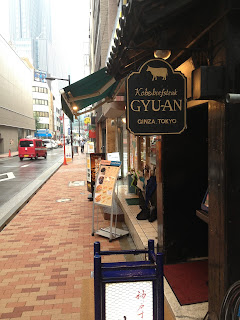
Gyu-an
6-13-6, Ginza, Chuo-ku, Tokyo
Monday - Saturday Lunch: 11:30 - 14:00(L.O.13:30)
Monday - Saturday Dinner: 17:30 - 22:00(L.O.21:30)
Holiday 17:00 - 21:30(L.O.21:00)
Closed on Sundays
Note: For reading the Japanese addreses like this, "Ginza" here refers to the neighbourhood and "Chuo-ku" refers to the ward. The three numbers separated by hyphens "6-13-6" mean "Chome (area), ban (block), go (building).